
The penultimate attempt, IPA #17, at right.
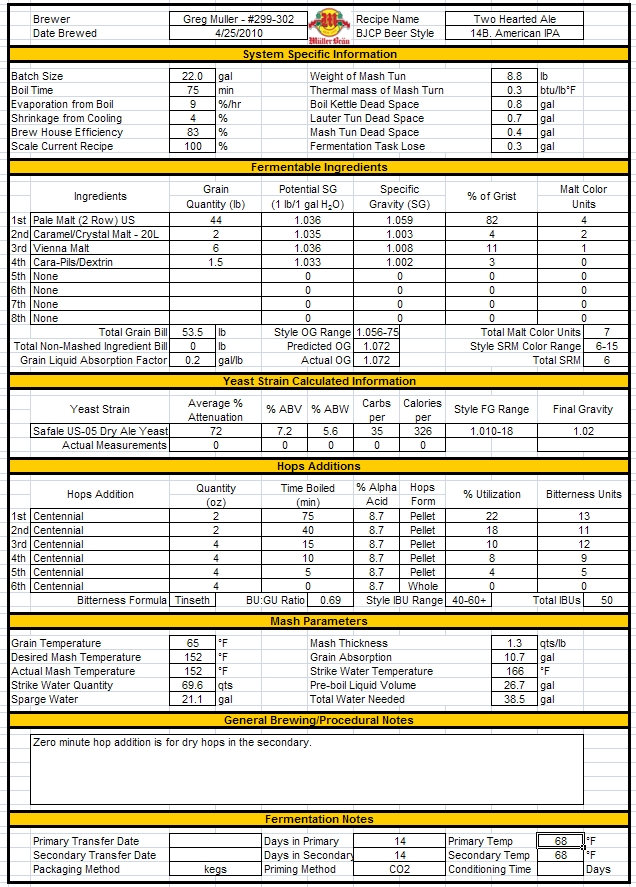
The recipe for Two Hearted is actually pretty straightforward. The base is regular domestic two-row pale malt, with a fairly significant dose of light Munich, and a small addition of light crystal malt. Some allegedly authentic sources suggest that Bell’s actually uses Vienna malt, but the Munich I use is rated 4-8 Lovibond, overlapping the typical range for Vienna considerably. Consult your maltster’s specifications and act accordingly. Hopping is 100% Centennial, of course, with more or less equal quantities for bittering, aroma, and dry-hop additions, doubled for the flavor addition. I like to split that between 20 and 10 minute doses, rather than a single addition at 15 minutes, because I feel that it gives a smoother and more complex hop flavor, at least in theory. Whether or not the difference is actually detectable, or which technique Bell’s uses, I couldn’t say.
In order to be 100% accurate, you’ll need to culture the yeast from a bottle; any of Bell’s American ales will use their house strain, so Oberon is probably the easiest source. Having brewed with both, though, I’ve found that I actually prefer Wyeast 1272. The differences are subtle, but its slightly fruitier esters seem to prolong the Centennial hop flavor, which is a plus if you won’t be finishing the keg for a couple months. I pitch at the standard 0.75 billion/L-°P, starting at 17°C/63°F, then let the beer rise on its own to 20°C/68°F and hold it there for the remainder of fermentation. Dry-hopping is conducted for 10 days at the same temperature.
I have to dilute my tap water 2:1 with reverse osmosis water to brew a beer this pale, then add gypsum and calcium chloride. The combined effect is to reduce the residual alkalinity to about 20 ppm CaCO3 and brings the pH to a perfect 5.3.
- Ca2+: 103 ppm
- Mg2+: 9 ppm
- Na+: 7 ppm
- SO42-: 144 ppm
- Cl–: 29 ppm
- HCO3–: 119 ppm
The last time I tasted the two beers side by side (pictured), they were extremely close, but I could still differentiate them, even tasting blind. The clone was a hair too dark, and also a little too malty. For this last revision, I reduced the Munich malt and increased the bittering charge slightly, and the two are now basically indistinguishable. About the only way I can reliably tell the difference is to finish a glass; the homebrew has better lacing.

Nicely done T! I’m quite impressed (of course I have bben with all of your master-brewing), but this is a huge feat for a great beer.
Man, I love the color.
And, thank you for the recipe.
Thanks! Have you brewed it yet? Let me know how it turns out.
Just finished the boil and the wort is cooling. My first taste impression is WoW. Since Bell’s isn’t sold around here (as far as I know, I’ll take a look at Whole Foods soon–I just did it for a good recipe) I may not be able to tell if it’s cloned. Regardless, at the end of the day, I get good beer.
Not yet. I think my next brew will be a pale. I would like to create a great session beer.
Hey hey,
Going to do a double batch this weekend, this beer and GI Summertime Kolsch clone. I do have two questions for you though: 1. the primary fermenter dry hopping is done post fermentation, right? 2. Did you rack direct to keg/bottle or did you transfer to secondary? How long did you leave it to dry hop before racking? Thanks!
What I do when dry-hopping is wait a few days after primary settles down, then cold crash the beer to ~50°F for a day or two, let the beer warm back into the 60s, and then dry-hop for seven days. After that I’ll crash it again, then go directly to the keg. I cold crash first because I think that at least approximates the yeast drop I would do if I were fermenting in a conical.
Sounds like a fun weekend. Let me know how the beer turns out. Who’s your maltster over there?
Sounds like a plan, and it saves me the time of cleaning a keg for secondary (I ferment in kegs).
For the moment I use Brouwland.com but once I’m done with my current supply I’m going to use these guys: http://maps.google.com/maps?f=q&source=s_q&hl=en&geocode=&q=Malteries+Franco+Belges,+Route+Malterie,+45300+Pithiviers-le-Vieil,+France&aq=0&sll=48.171695,2.236362&sspn=0.010747,0.033023&g=malterie+near+pithiviers,+france&ie=UTF8&hq=Malteries+Franco+Belges,&hnear=Route+de+la+Malterie,+45300+Pithiviers-le-Vieil,+Loiret,+Centre,+France&ll=48.170851,2.234066&spn=0.01069,0.033023&z=16
Apparently, France is the biggest provider of malt in Europe!
Thank you for this. Sounds perfect. I will brew it soon.
Enjoy, and let me know how it turns out!
To Philip Lamb:
How did your Goose Island Summertime turn out? I’d love to find out about your recipe and the success you had cloning the original.
Sorry for getting in on this so late.
Hi Sean,
I just bottled my 1st attempt with your clone recipe. I have to say that I will not be able to check whether my batch is cloned or not, since Bell’s doesn’t distribute to California.
Cloned or not, the batch–with its citrus bite and residual sweetness–tastes great.
[…] settled on a Bell’s Two Hearted IPA clone based roughly on the recipe provided by scientifically minded blogger, Sean […]
Hi Sean,
First, thanks for all that you share with the homebrewing community!
I’d like to get as close as possible to your recipe here.
Would you mind explaining your time and temp of the “steeped after boil” addition?
I’ve never steeped for any length of time after the boil. I’ve always just added at zero min and chilled immediately with immersion chiller.
Hey Eric,
It’s going to be pretty hard for me to say definitively. I would have had a pump at that point, but I don’t think I had put together a whirlpool arm yet, so I may or may not have manually stirred the kettle to whirlpool. I can say what I’d do now, which is probably closer to Bell’s SOP anyway:
At flameout, I add any whirlpool hops, cover the kettle, and recirculate through the whirlpool arm for 10 min, then let rest for 20 min before starting knockout. The whirlpool rest (hopefully) gives the hops and break material time to settle into a nice tight cone. As far as temperature, obviously I’m doing this straight off the boil, but bear in mind that my boil is at ~91°C for an IPA-gravity wort. Hope that helps.
Cheers,
Sean